
Overall Design, Structure, Research
2020
Locations:
ZAZ – Zentrum Architektur Zürich 2020
Time Space Existence, Venice Biennale 2021



Design Team:
Maria Pia Assaf, Jomana Baddad, Frederic Brisson, Yu-Hung Chiu, Rémy Clemente, Ioulios Georgiou, Mahiro Goto, Anton Johansson, Laszlo Mangliar, Dinorah Martinez Schulte, Edurne Morales Zuniga, Fatemeh Salehi Amiri, Emmanuelle Sallin, Indra Santosa, Eliott Sounigo, Chanon Techathuvanun, Ping-Hsun Tsai
Teaching Team:
Marirena Kladeftira (Project lead), Matthias Leschok, Eleni Skevaki (Chair of Digital Building Technologies, ETH Zurich), Davide Tanadini (Chair of Structural Design, ETH Zurich), Yael Ifrah (MAS ETH DFAB coordination, Chair of Digital Building Technologies)
Chair: Digital Building Technologies – ETH Zürich
Research Collaboration Partner: HS HI-TECH, Seoul, South Korea
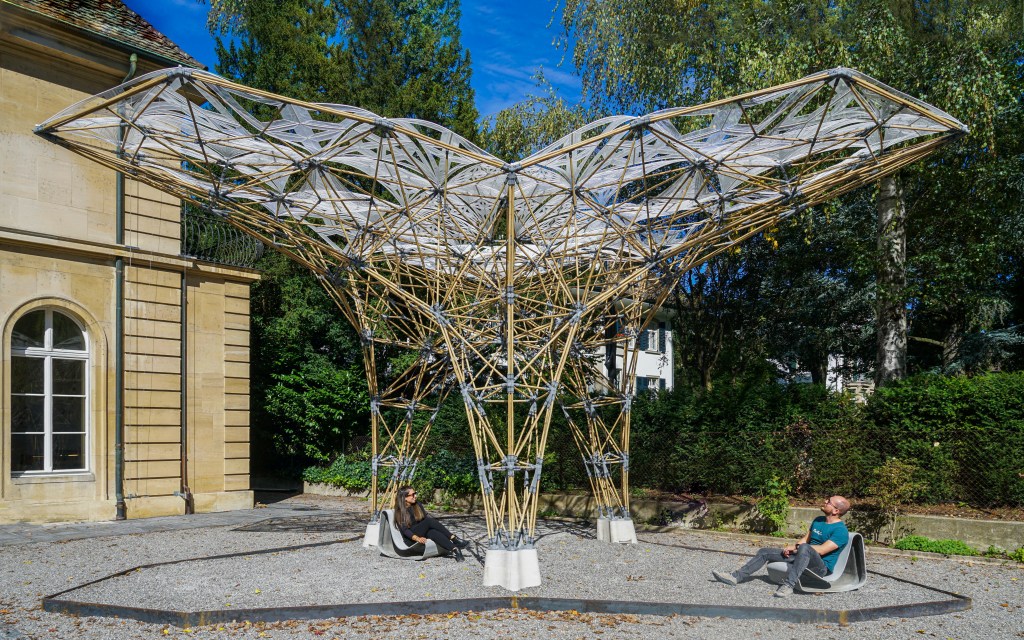
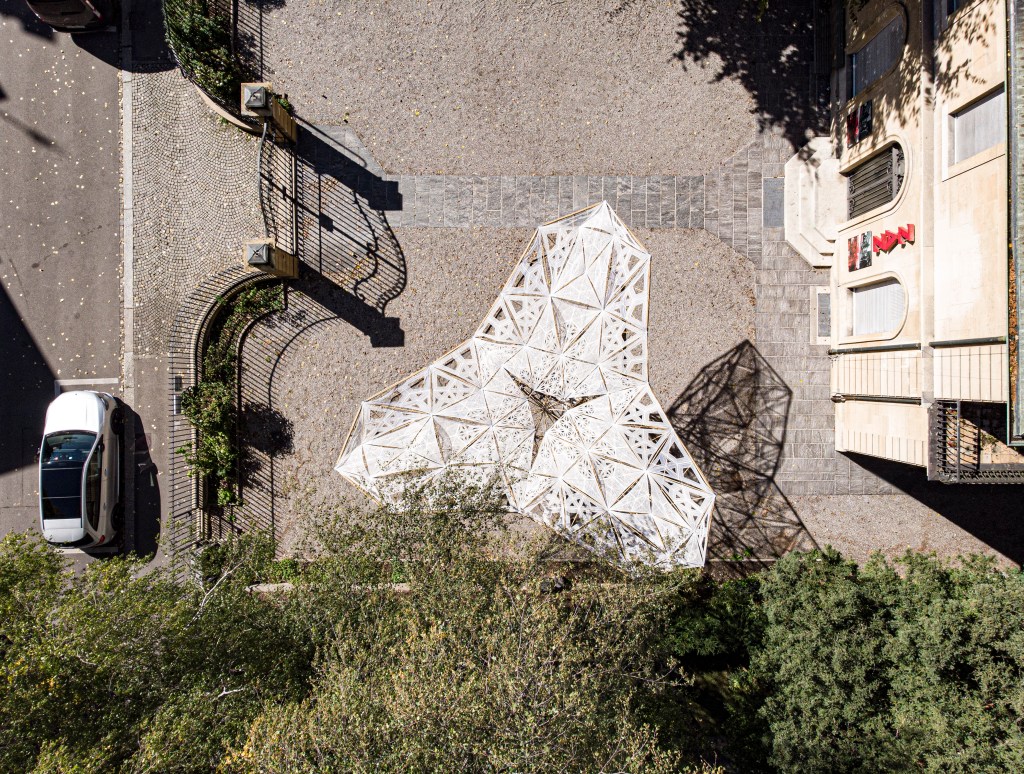
The Digital Bamboo pavilion explores the innovative combination of a naturally grown material with digital fabrication. Bamboo is an excellent sustainable building material, because of its rapid growth and very low weight-to-strength ratio. Customized computational tools were developed to design the ultra-lightweight structure, whose bespoke connections were manufactured using HP’s Multi Jet Fusion 3D printing technology. The structure covers more than 40 sqm with a total weight of only 200 kgs. The Digital Bamboo pavilion showcases a filigree and engaging architecture that surpasses
the standardized space frame vocabulary.
Computational design allows the optimization and formal exploration of complex structures. 3D printing gives the opportunity for architects and engineers to be more flexible when designing, as it breaks down barriers often presented by traditional manufacturing methods. The high-performance structure covers a large area, cantilevering almost 5 meters
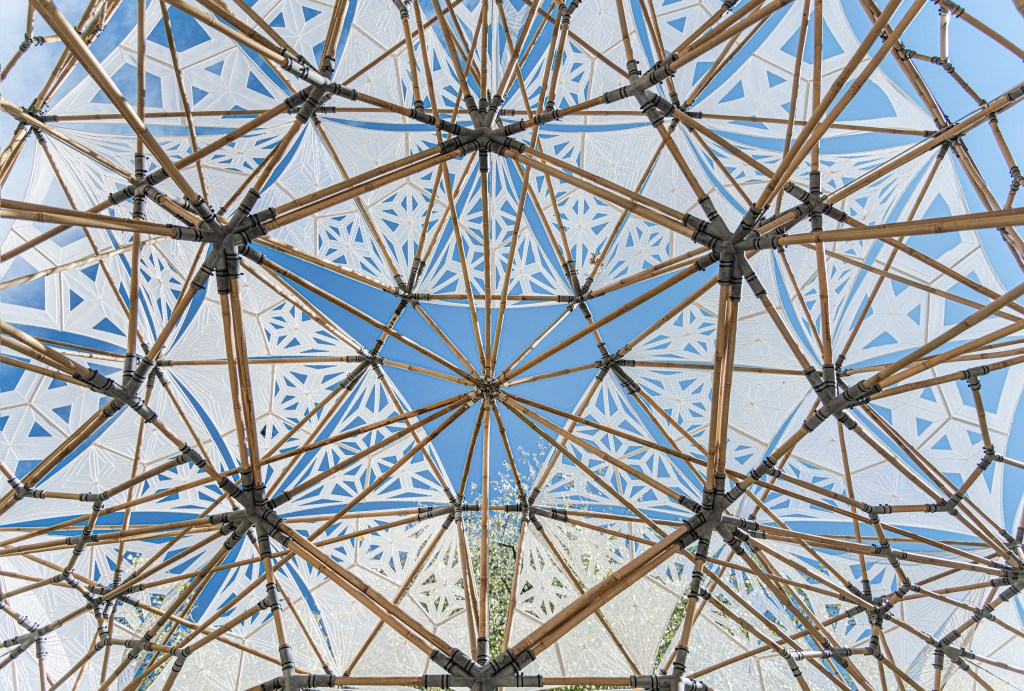
in three directions whilst requiring minimal support. The main load-bearing system is defined by a spatial truss reinforced by post-tensioned cables. The geometry of the pavilion, consisting of more than 900 bamboo elements, was form-foundusing specifically developed digital tools.
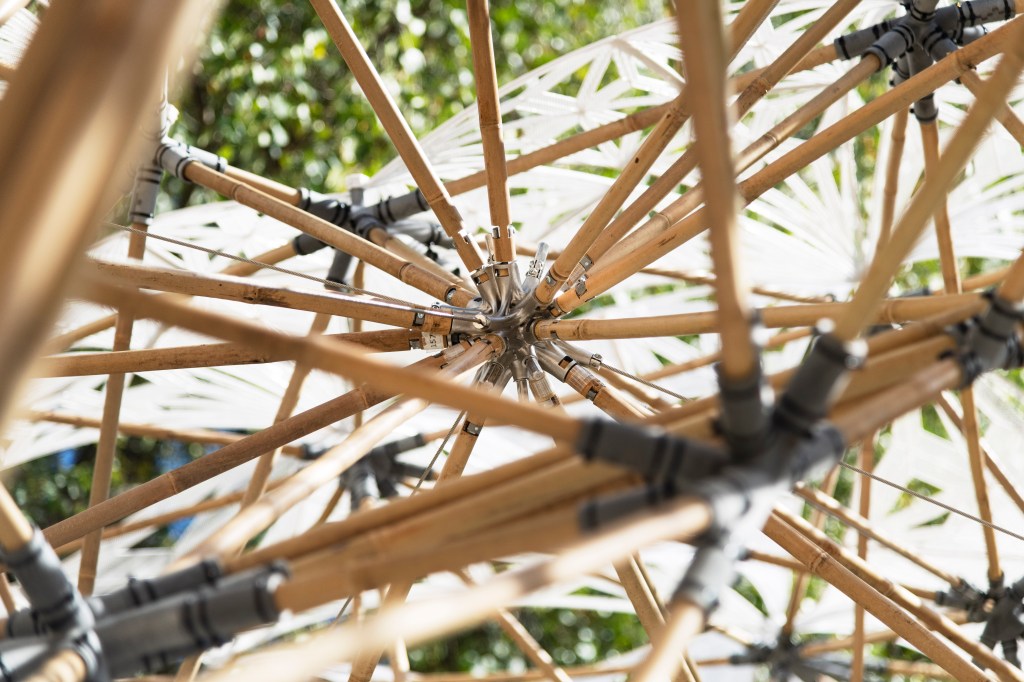
The bamboo elements are connected via a new system of plastic joints, based on 3D printing. The computational design process allowed an optimization of the manufacturing process of these joints from the first prototype to the final geometry – flexible and within a short time. The generation of each unique connection was automated thanks to a digital
process and developed to fulfill mechanical requirements. Their intricate geometry encapsulates necessary functions such as tolerances for assembly and bamboo inhomogeneities, connections to the shading panels, labeling, and cable fittings. In parallel, their volume is minimized to save time and cost. Using HP’s Multi Jet Fusion Technology for the 379 joints ensured a cost-effective production method with low material costs. The plastic parts were made of PA12, a very durable material which is particularly suitable for outdoor applications. One connection, where all the post-tensioning cables meet, was fabricated in stainless steel using DMLS technology.
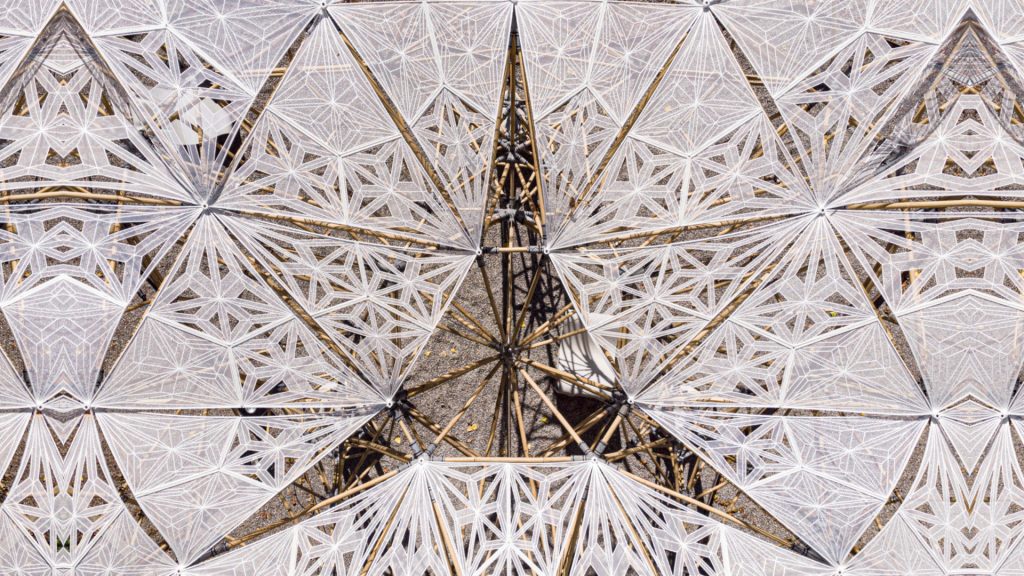
The shading panels of the pavilion are designed through a custom computational process and fabricated through add-on 3D printing of a recyclable UV resistant thermoplastic on a lightweight lycra textile. 3D printing stiffens and shapes the fabric into flexible bespoke panels. The composite elements are locally reinforced reducing the amount of material used. The construction system developed for the Digital Bamboo pavilion aims to reduce the logistic efforts of construction while exploiting the advantages of digital fabrication for more sustainable building culture. Following the principle of distributed prefabrication, the complexity of the structure is encapsulated in small parts that can be fabricated all over
the world using 3D printing. These custom parts can be used to construct high-performance structures together with local materials.
Thanks to a modular construction scheme, the structure allows fast assembly and disassembly. The pre-assembled parts of the pavilion were mounted on-site in only 48 hours. Digital Bamboo offers a new paradigm for how digital fabrication can lead to a sustainable future in construction, combining locally sourced materials with 3d printed parts to achieve new immersive architectural expression.

 ioulios georgiou